
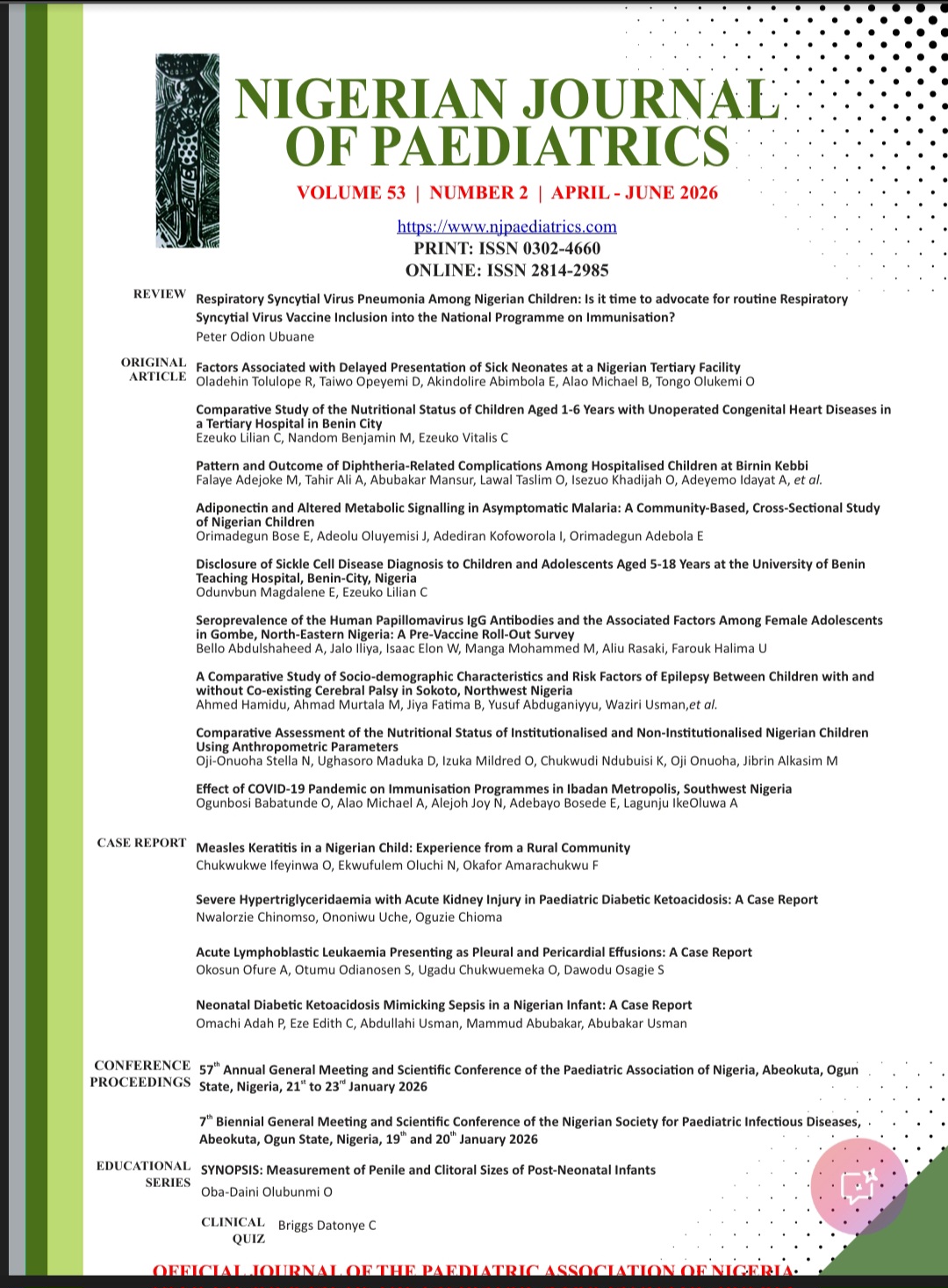
Adiponectin and Altered Metabolic Signalling in Asymptomatic Malaria: A Community-Based, Cross-Sectional Study of Nigerian Children
DOI:
https://doi.org/10.63270/njp.v53i2.2000060Keywords:
adipocytokines, adiponectin, asymptomatic malaria, laboratory medicine, Plasmodium falciparumAbstract
Background: Asymptomatic Plasmodium falciparum infection is common among school-aged children in endemic communities. Whether a microscopy-detectable infection is accompanied by a clinically important disturbance of adipocytokine signalling in apparently well children remains uncertain.
Objective: To determine whether microscopy-detectable asymptomatic Plasmodium falciparum infection is associated with changes in circulating adiponectin, leptin, resistin and the leptin-to-adiponectin ratio among afebrile Nigerian school-aged children.
Methods: A community-based, cross-sectional study was conducted among afebrile, symptom-screen-negative children aged 5-9 years, recruited from 20 public primary schools in Southwest Nigeria between March and June 2024. Malaria status was determined by microscopy of Giemsa-stained thick and thin blood films. Plasma adiponectin, leptin and resistin levels were measured by duplicate enzyme-linked immunosorbent assay, and the leptin-to-adiponectin ratio was calculated. Log-transformed outcomes were analysed using multivariable linear regression with school-level cluster-robust standard errors.
Results: Overall, 106/317 children (33.4%) had microscopy-detectable malaria. Baseline characteristics were broadly comparable, although malaria-positive children had lower mean weight-for-age z-scores. In the fully adjusted model, malaria positivity was not independently associated with adiponectin (-2.4%; 95% CI -10.9 to 6.9), leptin (-2.9%; 95% CI -11.4 to 6.4), resistin (2.1%; 95% CI -13.4 to 20.5) or the leptin-to-adiponectin ratio (-0.5%; 95% CI -11.2 to 11.4). Among malaria-positive children with parasite density data, adiponectin showed a weak positive monotonic association with parasite density (Spearman's rho = 0.31; p = 0.002).
Conclusion: Binary microscopy-defined asymptomatic malaria was not associated with major adipocytokine disruption. Parasite burden may carry a weak adiponectin signal, but the finding is hypothesis-generating and requires longitudinal studies using molecular parasite detection and fuller inflammatory-metabolic phenotyping.
Downloads
Published
Data Availability Statement
The de-identified dataset, analysis code and data dictionary supporting the findings are available on Zenodo at DOI: 10.5281/zenodo.17162616. The dataset contains no direct personal identifiers.
Issue
Section
License
Copyright (c) 2026 NIGERIAN JOURNAL OF PAEDIATRICS

This work is licensed under a Creative Commons Attribution 4.0 International License.
This is an open-access journal, and articles are distributed under the terms of the Creative Commons Attribution 4.0 License, which allows others to remix, transform, and build upon the work even, commercially, as long as appropriate credit is given to the author, and the new creations are licensed under identical terms
