
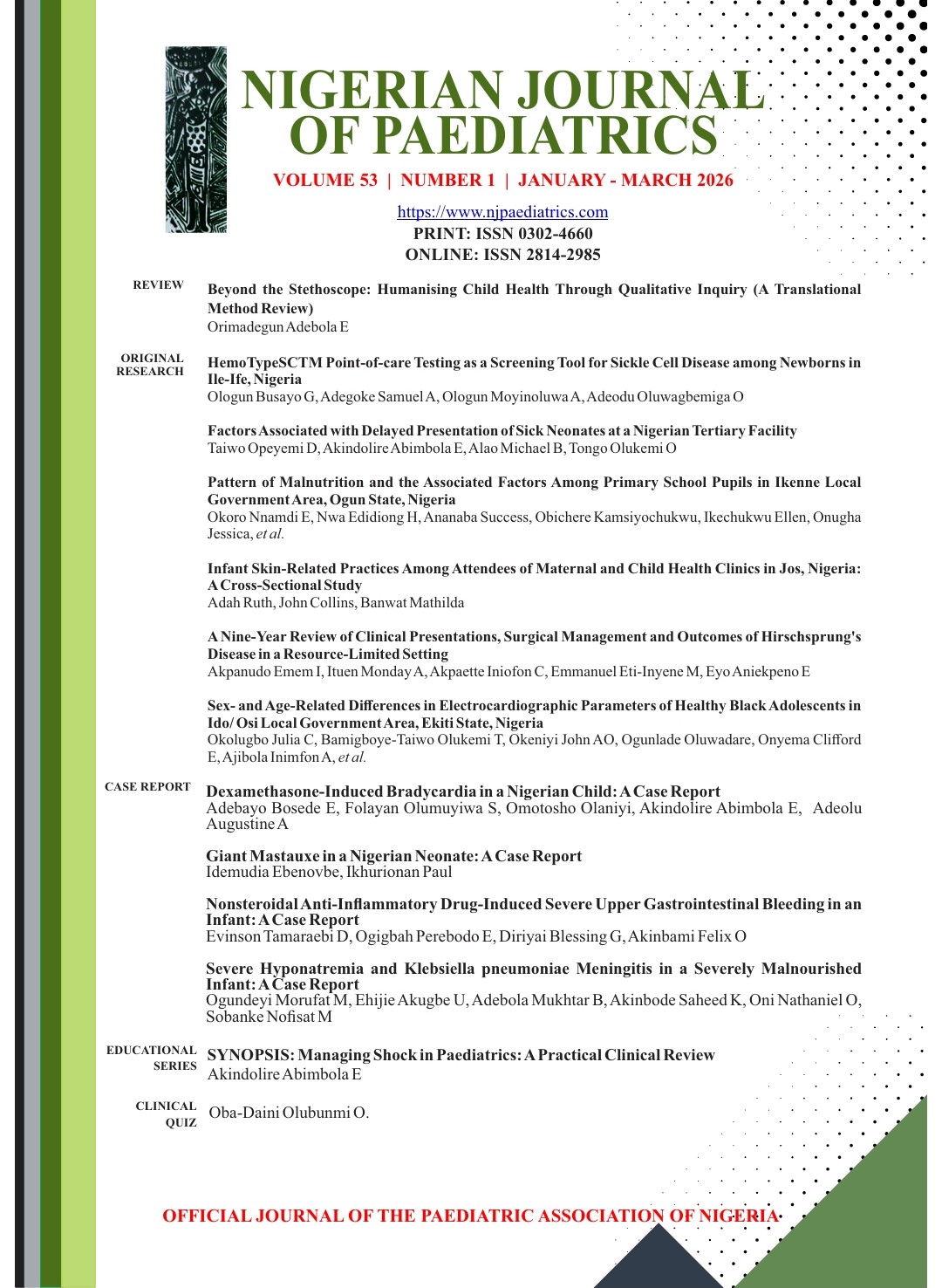
Beyond the Stethoscope: Humanising Child Health Through Qualitative Inquiry (A Translational Method Review)
DOI:
https://doi.org/10.63270/njp.v53i1.2000044Keywords:
Qualitative Inquiry, Child Health , Implementation Science, EthicsAbstract
Child survival remains a major priority in Nigeria and other low- and middle-income countries, yet proven interventions do not always translate into consistent uptake or better outcomes. Quantitative research is indispensable for describing burden, risk, and trends. Still, it often cannot explain why caregivers delay care, why adolescents disengage, or why technically sound services fail in everyday practice. This narrative review examines qualitative inquiry as a practical scientific method for addressing those gaps in paediatric care and programme delivery. A reproducible narrative review approach was used, with targeted searches of PubMed/MEDLINE, Scopus, Web of Science, African Journals Online, and Google Scholar, supplemented by citation tracking of key methodological and implementation sources. Sources were purposively selected and synthesised around four questions: what qualitative inquiry contributes to translational child health; which methods are feasible for clinicians and trainees; how rigour and ethics should be handled; and how findings can inform service redesign. The review shows that qualitative inquiry strengthens paediatric practice by clarifying acceptability, feasibility, trust, hidden costs, and workflow realities across child, facility, and policy levels. It provides clinician-facing guidance on interviews, focus group discussions, observation, sampling, analysis, trustworthiness, and safeguarding, and demonstrates how qualitative findings can be translated into practical redesign actions. Qualitative inquiry should be treated as a core method in paediatric implementation and training, not as an informal add-on.
Downloads
Published
Data Availability Statement
Not applicable
Issue
Section
License
Copyright (c) 2026 NIGERIAN JOURNAL OF PAEDIATRICS

This work is licensed under a Creative Commons Attribution 4.0 International License.
This is an open-access journal, and articles are distributed under the terms of the Creative Commons Attribution 4.0 License, which allows others to remix, transform, and build upon the work even, commercially, as long as appropriate credit is given to the author, and the new creations are licensed under identical terms
