
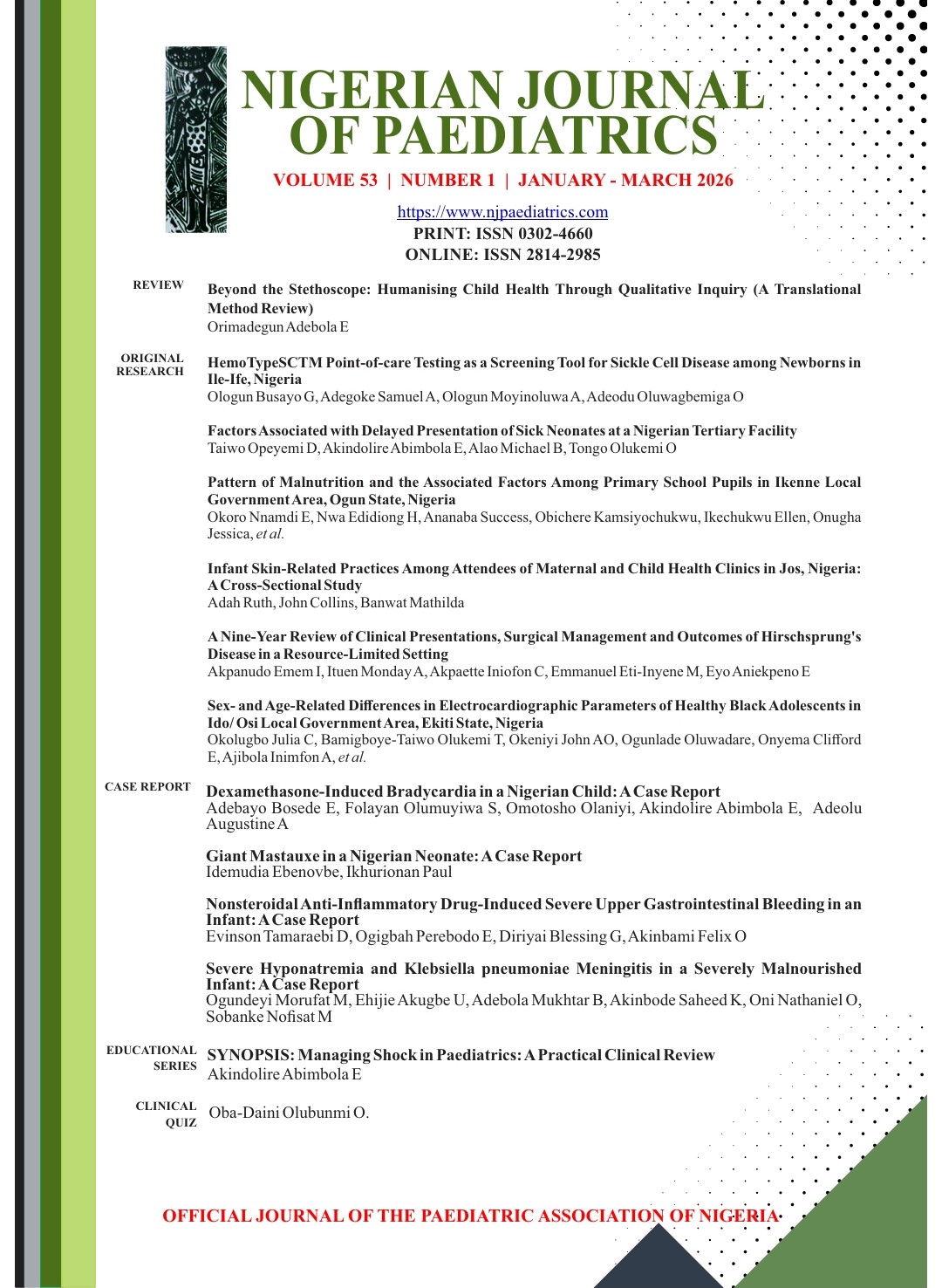
Pattern of Malnutrition and the Associated Factors Among Primary School Pupils in Ikenne Local Government Area, Ogun State, Nigeria
DOI:
https://doi.org/10.63270/njp.v53i1.2000046Abstract
Background: Malnutrition is currently a major problem among school-age children in Nigeria, with studies reporting prevalences of over 20% and almost 10% for stunting and obesity, respectively. Adequate facts are required for evidence-based solutions to address this problem.
Objective: To determine the prevalence of malnutrition and its associated factors among primary school pupils in Ikenne Local Government Area (LGA), Ogun State, Nigeria.
Methods: This was a descriptive, cross-sectional study among 320 primary school pupils aged 6-12 years, selected through a multistage sampling technique. The study instrument was a purpose-developed, pretested, interviewer-administered questionnaire, while body weight and height were measured using a Desco weighing scale and stadiometer.
Results: The mean age of the participants was 8.6 ± 1.9 years, while 50.9% (163/320) were female. The study showed that 28.4%, 12.2%, 7.5%, 20.0% and 8.4% of the children were stunted, wasted, underweight, overweight and obese, respectively. Age (p = 0.016) and gender (p = 0.005) were significantly associated with underweight, while age was significantly associated with wasting, stunting, overweight and obesity (p = 0.001). Age was also a significant predictor of stunting (AOR = 0.538, 95% CI = 0.300-0.963 and 0.417, 0.203-0.859, respectively) and overweight (AOR = 0.357, 95% CI = 0.195-0.655 and 0.295, 0.121-0.720, respectively).
Conclusion: Malnutrition is common among pupils in Ikenne LGA of Nigeria and needs to be addressed. School-age children should be fed appropriately and encouraged to maintain regular physical activity to ensure a good nutritional status.
Downloads
Published
Data Availability Statement
May be available on a reasonable request.
Issue
Section
License
Copyright (c) 2026 NIGERIAN JOURNAL OF PAEDIATRICS

This work is licensed under a Creative Commons Attribution 4.0 International License.
This is an open-access journal, and articles are distributed under the terms of the Creative Commons Attribution 4.0 License, which allows others to remix, transform, and build upon the work even, commercially, as long as appropriate credit is given to the author, and the new creations are licensed under identical terms
