
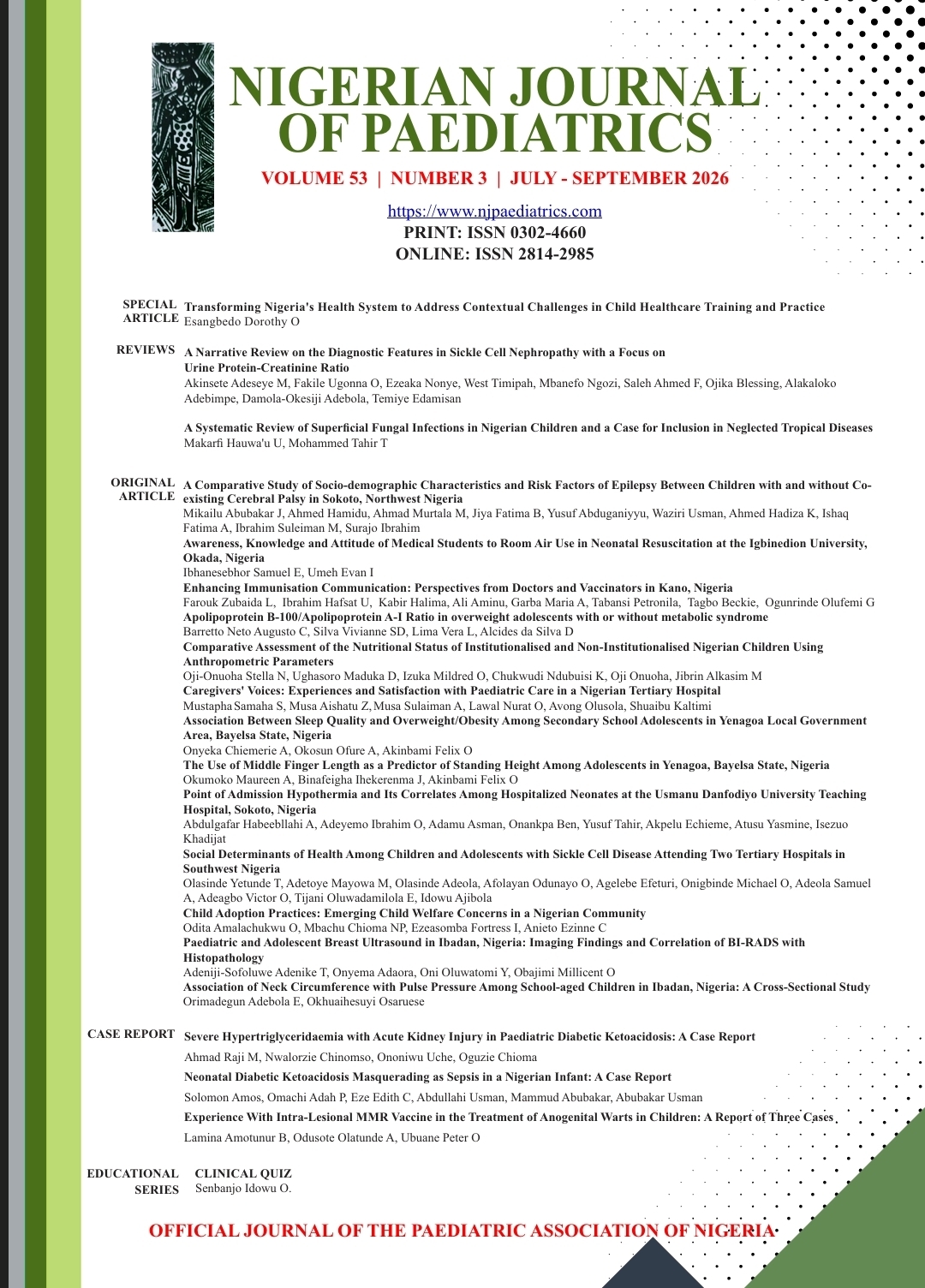
Transforming Nigeria’s Health System to Address Contextual Challenges in Child Healthcare, Training and Practice
DOI:
https://doi.org/10.63270/Keywords:
Child health, Child survival, Health financing, Health system policy, Nigeria, Under-five mortality.Abstract
Nigeria bears a disproportionate burden of child mortality, accounting for approximately 17% of global under-five deaths and having one of the highest under-five mortality rates in the world, estimated at 115.6 deaths per 1,000 live births. Most children die in the first month of life, with the neonatal mortality rate estimated to remain at about 41 deaths per 1,000 live births in the 2024 Nigeria Demographic and Health Survey. The pattern of child morbidity and mortality reflects marked geographical, socioeconomic, and demographic disparities. Children living in rural communities, conflict-affected areas, and poorer households face significantly greater risks of illness and death than those in urban and wealthier settings. From primary care interventions which have been demonstrated to improve child survival, such as immunisation, adequate breastfeeding, nutrition and oral rehydration therapy, it is of note that the current child health landscape presents a paradox of progress amidst persistent challenges. Mortality rates have declined, but the magnitude of preventable child deaths remains unacceptable. To accelerate progress, the country needs to address the contextual factors that undermine child survival, growth, and development. This requires a transformative approach to health system strengthening. In fact, the National Primary Health Care Development Agency (NPHCDA), which is the government institution mandated to drive the primary health care strategy in Nigeria, needs to be strengthened to overcome the constraints caused by persistent systemic challenges, including poor access to services, an insufficient health workforce, and suboptimal financing practices. The school health programme, school feeding programme and care of children with special needs are equally important child survival needs. To achieve sustainable economic growth, reducing child mortality should be viewed as a national development strategy rather than simply a health sector objective. Therefore, child healthcare providers and child health advocates are required to double down on advocacy focused on health policymakers, financiers, and the public. These steps will energise the existing health system and boost and sustain other public health interventions that are relevant to child survival.
Downloads
Published
Issue
Section
License
Copyright (c) 2026 NIGERIAN JOURNAL OF PAEDIATRICS

This work is licensed under a Creative Commons Attribution 4.0 International License.
This is an open-access journal, and articles are distributed under the terms of the Creative Commons Attribution 4.0 License, which allows others to remix, transform, and build upon the work even, commercially, as long as appropriate credit is given to the author, and the new creations are licensed under identical terms
